A SCREENING OF:
A LETTER TO THE WEST SIDE
A SCREENING OF:
A LETTER TO THE WEST SIDE
A SCREENING OF:
A LETTER TO THE WEST SIDE
Context
Ubuntu Communities and the Community Leadership Council presented a screening at Ann Arbor Open School of A Letter to the West Side. The documentary by Kameron Donald was released in February 2025, with its debut held at the Michigan Theater. The recent screening was held at Ann Arbor Open School at Mack, a school located directly in the West Side of Ann Arbor itself.
The film documents the gentrification and redlining that reshaped the West Side, and the organizations' goal was to bring that story to broader communities across Ann Arbor, starting with the West Side itself. One of the most pointed symbols of that displacement is the neighborhood name "Water Hill": the name now used on GPS services, replacing the name the community has always known it by.
I was tasked with creating a promotional flyer for the screening—one that didn't just advertise an event, but acknowledged where it was taking place and why that mattered.
Challenge
The film and its story had largely circulated within the same audience, which limited broader exposure to the history it documents. The flyer needed to reach beyond that existing circle without maintaining the weight and community it represented.
The material had to resonate with longtime community members who lived this history while also engaging people encountering the story for the first time. Additionally, the promotion had to be done without aestheticizing displacement. The subject matter required care: acknowledge the history and community, and stretch to new audiences.
Strategy
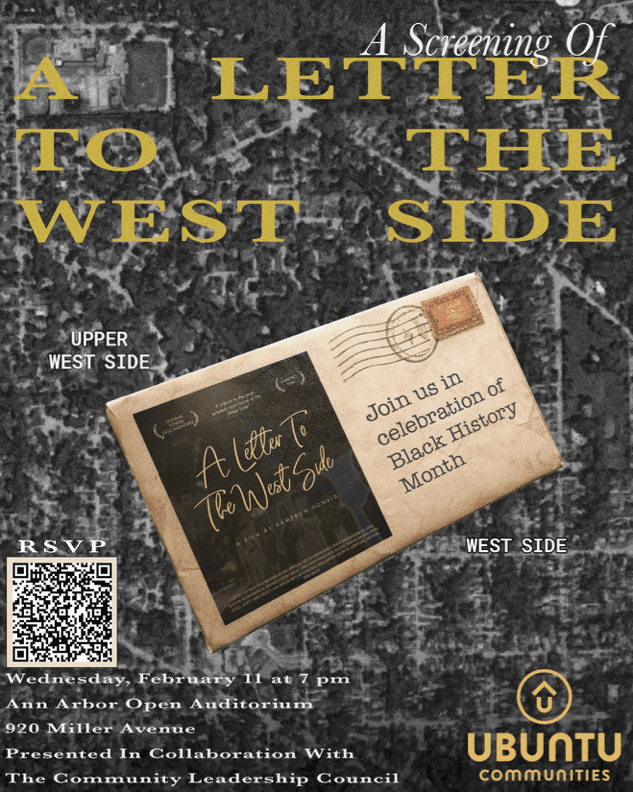
The central visual decision was to use the neighborhood itself as the backdrop—a satellite image of the actual West Side—so that the people this story belongs to could see their community centered and recognized in the flyer itself.
I layered GPS-style text reading "West Side" and "Old West Side" directly onto the image, reclaiming the neighborhood's name within the promotional material itself. This connected to the film's title and the broader act of acknowledgment the screening represented.
Structurally, the flyer borrowed the form of a letter, a nod to the film's name and framing the event as an invitation rather than just an announcement. The flyer also incorporated original branding (font, color, style, and promotional image) from the film itself. All necessary event information (date, time, location, RSVP QR code, presenter credits) was incorporated clearly, so the design could carry meaning without sacrificing function.
Execution
The final flyer was distributed both digitally and posted in person at select locations around Ann Arbor.
Background: Satellite image of the West Side neighborhood with a black-and-white, textured treatment—grounding the flyer in place without turning the neighborhood into an aesthetic
Text overlay: GPS map-style "West Side" and "Old West Side" labels reclaiming the neighborhood's name within the design
Typography: Vibrant yellow with a grainy texture for readability, tonally consistent with both the flyer's gravity and the film's visual language
Header framing: "A Screening Of" placed above the film title to signal the event format while foregrounding the film's own name and identity
Results
The flyer and event reached audiences both inside and outside the community, contributing to the broader exposure the organizers were working toward. When the flyer was shared to members of the community before the screening, the response went beyond simple recognition of the event; some of the elders got emotional seeing the satellite image of their neighborhood in the background. That reaction was the clearest signal that the design had done what it was meant to do: not only promote the screening, but also add to the recognition the community deserves.
Context
Ubuntu Communities and the Community Leadership Council presented a screening at Ann Arbor Open School of A Letter to the West Side. The documentary by Kameron Donald was released in February 2025, with its debut held at the Michigan Theater. The recent screening was held at Ann Arbor Open School at Mack, a school located directly in the West Side of Ann Arbor itself.
The film documents the gentrification and redlining that reshaped the West Side, and the organizations' goal was to bring that story to broader communities across Ann Arbor, starting with the West Side itself. One of the most pointed symbols of that displacement is the neighborhood name "Water Hill": the name now used on GPS services, replacing the name the community has always known it by.
I was tasked with creating a promotional flyer for the screening—one that didn't just advertise an event, but acknowledged where it was taking place and why that mattered.
Context
Ubuntu Communities and the Community Leadership Council presented a screening at Ann Arbor Open School of A Letter to the West Side. The documentary by Kameron Donald was released in February 2025, with its debut held at the Michigan Theater. The recent screening was held at Ann Arbor Open School at Mack, a school located directly in the West Side of Ann Arbor itself.
The film documents the gentrification and redlining that reshaped the West Side, and the organizations' goal was to bring that story to broader communities across Ann Arbor, starting with the West Side itself. One of the most pointed symbols of that displacement is the neighborhood name "Water Hill": the name now used on GPS services, replacing the name the community has always known it by.
I was tasked with creating a promotional flyer for the screening—one that didn't just advertise an event, but acknowledged where it was taking place and why that mattered.
Challenge
The film and its story had largely circulated within the same audience, which limited broader exposure to the history it documents. The flyer needed to reach beyond that existing circle without maintaining the weight and community it represented.
The material had to resonate with longtime community members who lived this history while also engaging people encountering the story for the first time. Additionally, the promotion had to be done without aestheticizing displacement. The subject matter required care: acknowledge the history and community, and stretch to new audiences.
Strategy
The central visual decision was to use the neighborhood itself as the backdrop—a satellite image of the actual West Side—so that the people this story belongs to could see their community centered and recognized in the flyer itself.
I layered GPS-style text reading "West Side" and "Old West Side" directly onto the image, reclaiming the neighborhood's name within the promotional material itself. This connected to the film's title and the broader act of acknowledgment the screening represented.
Structurally, the flyer borrowed the form of a letter, a nod to the film's name and framing the event as an invitation rather than just an announcement. The flyer also incorporated original branding (font, color, style, and promotional image) from the film itself. All necessary event information (date, time, location, RSVP QR code, presenter credits) was incorporated clearly, so the design could carry meaning without sacrificing function.
Execution
The final flyer was distributed both digitally and posted in person at select locations around Ann Arbor.
Background: Satellite image of the West Side neighborhood with a black-and-white, textured treatment—grounding the flyer in place without turning the neighborhood into an aesthetic
Text overlay: GPS map-style "West Side" and "Old West Side" labels reclaiming the neighborhood's name within the design
Typography: Vibrant yellow with a grainy texture for readability, tonally consistent with both the flyer's gravity and the film's visual language
Header framing: "A Screening Of" placed above the film title to signal the event format while foregrounding the film's own name and identity
Results
The flyer and event reached audiences both inside and outside the community, contributing to the broader exposure the organizers were working toward. When the flyer was shared to members of the community before the screening, the response went beyond simple recognition of the event; some of the elders got emotional seeing the satellite image of their neighborhood in the background. That reaction was the clearest signal that the design had done what it was meant to do: not only promote the screening, but also add to the recognition the community deserves.
Challenge
The film and its story had largely circulated within the same audience, which limited broader exposure to the history it documents. The flyer needed to reach beyond that existing circle without maintaining the weight and community it represented.
The material had to resonate with longtime community members who lived this history while also engaging people encountering the story for the first time. Additionally, the promotion had to be done without aestheticizing displacement. The subject matter required care: acknowledge the history and community, and stretch to new audiences.
Strategy
The central visual decision was to use the neighborhood itself as the backdrop—a satellite image of the actual West Side—so that the people this story belongs to could see their community centered and recognized in the flyer itself.
I layered GPS-style text reading "West Side" and "Old West Side" directly onto the image, reclaiming the neighborhood's name within the promotional material itself. This connected to the film's title and the broader act of acknowledgment the screening represented.
Structurally, the flyer borrowed the form of a letter, a nod to the film's name and framing the event as an invitation rather than just an announcement. The flyer also incorporated original branding (font, color, style, and promotional image) from the film itself. All necessary event information (date, time, location, RSVP QR code, presenter credits) was incorporated clearly, so the design could carry meaning without sacrificing function.
Execution
The final flyer was distributed both digitally and posted in person at select locations around Ann Arbor.
Background: Satellite image of the West Side neighborhood with a black-and-white, textured treatment—grounding the flyer in place without turning the neighborhood into an aesthetic
Text overlay: GPS map-style "West Side" and "Old West Side" labels reclaiming the neighborhood's name within the design
Typography: Vibrant yellow with a grainy texture for readability, tonally consistent with both the flyer's gravity and the film's visual language
Header framing: "A Screening Of" placed above the film title to signal the event format while foregrounding the film's own name and identity
Results
The flyer and event reached audiences both inside and outside the community, contributing to the broader exposure the organizers were working toward. When the flyer was shared to members of the community before the screening, the response went beyond simple recognition of the event; some of the elders got emotional seeing the satellite image of their neighborhood in the background. That reaction was the clearest signal that the design had done what it was meant to do: not only promote the screening, but also add to the recognition the community deserves.
BACK TO TOP